
Tracking 101: How CDS Trains Dogs to Find What Others Miss
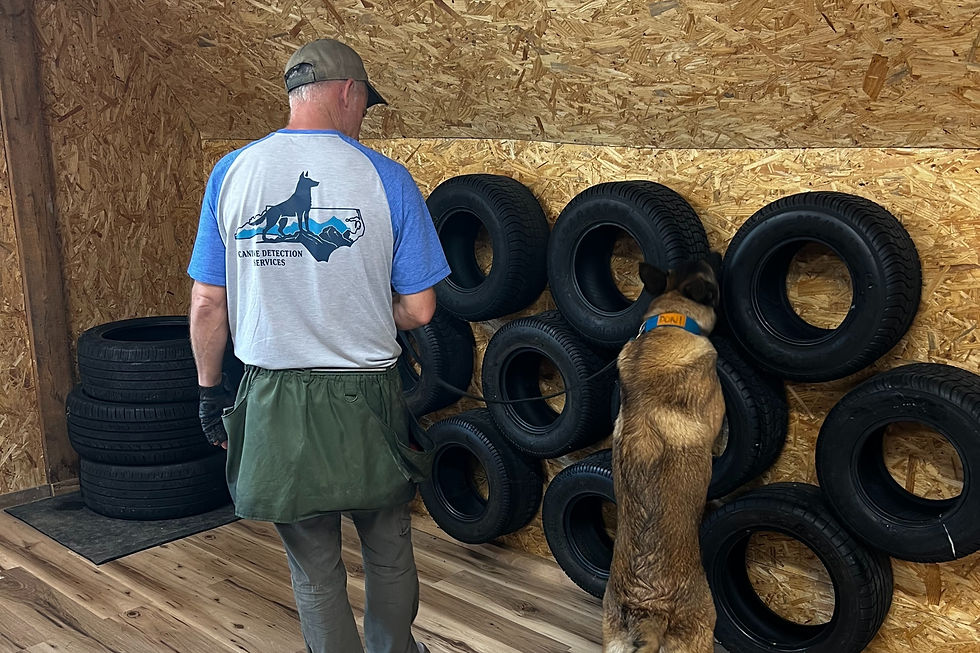
A dog's nose is one of the most powerful tools in law enforcement and military work, ultimately capable of detecting what no piece of equipment can replicate. However, the ability to detect specific substances, odors, and even people doesn’t happen on its own. That skill is built, step by step, through a deliberate training process designed to turn natural instinct into a reliable, deployable skill. As a professional canine trainer specializing in canine scent detection work, I've refined a process that consistently produces search dogs and drug detection dogs ready to perform in the field.
It All Starts With a Scuff in the Dirt
Scent detection training doesn't begin with complex scenarios or high-pressure searches. It begins with something deceptively simple. Our head trainer starts each dog's foundation by scuffing the ground and placing a piece of the K-9’s daily food intake in that disturbed patch of earth. That small scuff in the dirt creates the dog's very first association between a human scent profile and a reward.
It sounds basic, and that's exactly the point. Before a dog can search a vehicle, a building, or a person, it has to understand the core concept underlying all scent detection work: find the source of the scent, and good things happen. Every later stage of training builds on that same principle. The environments get more complex, the scents get more specific to the target odor, and the searches get more demanding, but the foundation never changes.
From Foundation to Fieldwork
Once that initial scent association is established, training progresses in stages designed to build the dog's confidence, accuracy, and independence. Over roughly eight weeks, the dog moves from simple, controlled exercises to more realistic search scenarios:
Early scent association: building the dog's understanding that locating a specific odor leads to reward, starting with that first scuffed patch of ground
Increasing search complexity: moving from open, simple areas to other real-world search environments to include gravel and hard surfaces
Independent searching: teaching the dog to work a space methodically without constant handler direction, so it can cover ground efficiently and reliably
Handler transition readiness: through repetition and clarity in the exercise during each phase, a new handler will learn to read the dog's alerts accurately
By the end of the training window, the dog has developed a level of consistency and reliability that allows the handler to track with confidence, and the ability to recognize the behavior changes from the dog that will lead to success.
What This Means for Agencies Evaluating a Professional Canine Trainer
Scent detection work is a skill built on repetition, consistency, and a training philosophy that never skips foundational steps. Whether the end goal is a search dog, a drug detection dog, or a broader scent detection role, the process starts the same way: with a simple, deliberate scent association and a trainer who understands that every later stage depends on getting that foundation right.
If you're an agency exploring canine scent detection work and want to understand more about how CDS builds dogs capable of finding what others miss, we'd welcome the opportunity to walk you through our process from that first scuffed patch of ground to a fully field-ready dog. Contact us today!

Comments